close
Choose Your Site
Global
Social Media
Views: 123 Author: Site Editor Publish Time: 2026-11-23 Origin: Site
Standard carbon and stainless steel fasteners fail predictably in high-chloride, submerged, or high-voltage environments. When structural integrity or continuous conductivity is non-negotiable, engineers turn to specialized copper alloys. Silicon bronze offers a unique intersection of high tensile strength, exceptional corrosion resistance, and electrical conductivity. It primarily consists of an alloy of copper and silicon, commonly designated as C65100 or C65500. You will frequently see these specialized metals replacing cheaper hardware in situations where unexpected failure presents severe safety risks or operational delays.
This guide outlines the specific industrial, marine, and electrical applications where silicon bronze hardware serves as the required standard. We will explore why these environments destroy standard fasteners and how copper alloys solve those specific problems. You will also get a practical framework for evaluating these premium fasteners against cheaper alternatives. We aim to help you select the precise material needed for your next critical project.
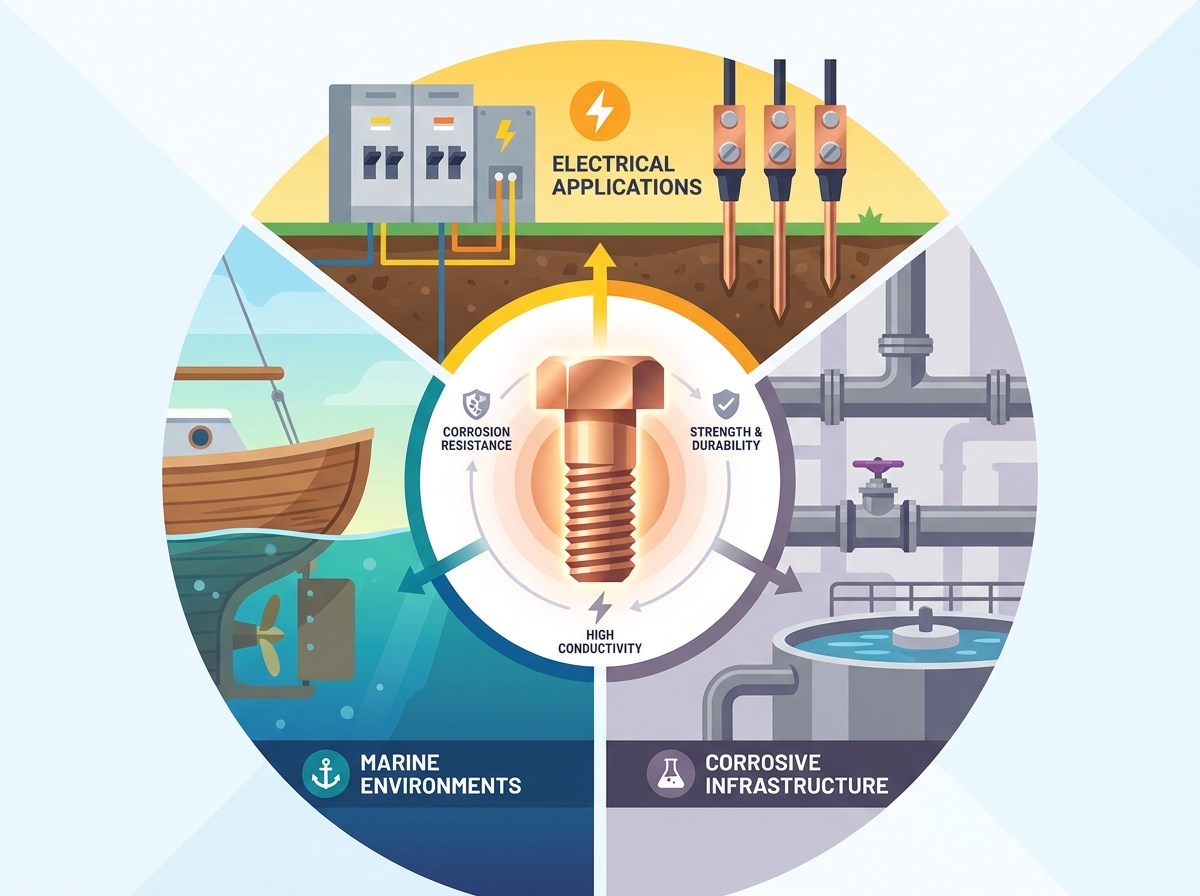
Silicon bronze bolts are primarily used in marine environments because they resist saltwater corrosion and do not suffer from the crevice corrosion that plagues stainless steel.
Due to their high copper content, silicon bronze bolts for electrical applications are the industry standard for grounding systems and heavy-duty electrical connections.
While more expensive than brass or standard 304/316 stainless steel, silicon bronze offers superior tensile strength and eliminates the risk of dezincification.
Proper implementation requires attention to torque limits, as silicon bronze has different yield characteristics compared to hardened steel.
Fastener failure in critical infrastructure usually stems from galvanic corrosion, chemical exposure, or mechanical galling. Plated steel hardware degrades rapidly once moisture breaches its protective zinc coating. Even premium structural metals struggle in specific niche environments. Business operators often face repeated maintenance cycles because they selected an improper alloy for their specific environmental challenges. By deploying silicon bronze bolts, project managers can drastically reduce the frequency of mechanical failures.
Stainless steel relies on oxygen to maintain a microscopic passive oxide layer. In submerged saltwater applications lacking oxygen, standard stainless steel loses this defensive barrier. This phenomenon leads to rapid, hidden deterioration known as crevice corrosion. A stainless bolt may look pristine on the bolt head while the threads inside the wood or metal completely rot away. This hidden deterioration creates extreme hazards in marine and submerged industrial environments.
Steel and stainless steel are inherently poor electrical conductors. In high-amperage electrical terminals, poor conductivity creates dangerous resistance. Resistance generates heat. Over time, thermal cycling loosens the connection, generating even more heat. This cycle frequently results in melted terminals, arcing, or devastating panel fires. Standard hardware simply cannot support continuous, heavy electrical loads.
Foundries create silicon bronze by blending copper primarily with silicon, often adding trace amounts of manganese, iron, or tin. The resulting alloy achieves the physical clamping strength of mild carbon steel. However, unlike carbon steel, it remains non-magnetic, highly conductive, and virtually immune to standard environmental degradation. This unique metallurgical profile solves both the crevice corrosion problem and the conductivity gap simultaneously.
Shipwrights and marine engineers have relied on copper-silicon alloys for decades. The ocean creates an incredibly hostile environment for metal. Assessing the lifecycle of fasteners in tidal zones, wooden boat construction, and submerged mechanical parts reveals why standard metals fall short.
Silicon bronze remains the mandatory specification for fastening hull planks to ribs in traditional boat building. Certain woods, like oak and cedar, contain high levels of naturally occurring tannic acids. These acids aggressively attack steel and galvanized hardware. Silicon bronze resists these corrosive wood acids. It provides decades of secure holding power inside wet timber.
Oxygen deprivation makes stainless steel a serious liability for submerged mechanical components. Marine mechanics utilize copper alloys extensively in rudders, struts, and propeller shafts. These below-waterline areas experience continuous saltwater immersion. Because silicon bronze does not require oxygen to maintain its corrosion resistance, it survives indefinitely underwater.
Vessel owners coat their hulls using anti-fouling paints to prevent barnacle growth. These paints typically contain high concentrations of copper biocides. If you use stainless steel or aluminum fasteners near copper-based paints in saltwater, you will trigger severe galvanic corrosion. Silicon bronze interacts safely with these anti-fouling hull paints. The similar metallurgical base prevents dissimilar metal reactions.
Always pre-drill holes in dense hardwoods to prevent fastener shearing.
Avoid mixing stainless steel washers or nuts on a silicon bronze bolt.
Use a marine-grade sealant to prevent water ingress along the thread path.
Electrical engineers face a delicate balancing act. They need materials capable of transferring electrical current efficiently, but they also need substantial mechanical clamping force. High electrical conductivity paired with physical clamping force ensures stable, low-resistance connections in power distribution systems.
Engineers specify silicon bronze bolts for electrical applications specifically for direct-burial grounding tasks. Grounding rods and earth grids sit buried in damp soil for decades. Soil pH fluctuates widely, often creating highly corrosive conditions. These specialized bolts resist soil corrosion and maintain perfect electrical conductivity over their entire lifespan. They secure ground wires to copper rods without degrading underground.
Heavy-duty terminal connections experience intense thermal cycling. Continuous current flow degrades lesser metals rapidly. Inside industrial switchgear and massive utility transformers, installers utilize silicon bronze hardware to clamp heavy cables. The alloy provides enough physical yield strength to crush the copper lugs securely together. This tight physical bond prevents electrical arcing and minimizes dangerous resistance.
Most commercial power distribution relies on heavy copper busbars and copper wiring lugs. Bolting these copper components together using steel hardware introduces dissimilar metals into the system. Moisture in the air acts as an electrolyte, triggering galvanic corrosion. The steel fastener will slowly rust, compromising the connection. Using copper-alloy fasteners entirely eliminates the risk of dissimilar metal corrosion.
Beyond marine and electrical fields, aggressive chemical environments require specialized hardware. Municipalities and industrial plant operators rely on copper-silicon alloys to keep critical fluid infrastructure intact.
Wastewater and chemical treatment plants process highly volatile substances. Sludge processing and chemical mixing generate corrosive off-gassing. This airborne vapor destroys standard zinc-plated or mild steel hardware within months. Plant engineers deploy silicon bronze across catwalks, pipe flanges, and pump housings to resist this aggressive chemical vapor.
Municipal pipe flanges and drinking water valves require compliance-aware implementation. Strict regulations govern which metals can touch public drinking water. Because silicon bronze is typically lead-free, it complies with safe drinking water standards. Furthermore, municipalities use copper piping extensively. Using matching alloy fasteners prevents galvanic reactions across the municipal pipe network.
Heritage masonry restoration and high-end woodworking projects utilize these fasteners for both structural strength and aesthetic appeal. When iron bolts get wet, they bleed rust down the face of historical stone buildings, causing permanent stains. Silicon bronze will not rust. Instead, it naturally oxidizes into an aesthetically pleasing green or brown patina, blending perfectly into historical architecture.
Engineers must balance upfront procurement costs against lifecycle longevity and maintenance risks. Choosing the wrong fastener often leads to catastrophic failure. We must establish a clear decision framework for selecting the appropriate alloy.
Stainless steel wins on absolute tensile strength and widespread availability. It is easier to source and costs less. However, silicon bronze wins decisively in low-oxygen saltwater environments and electrical conductivity scenarios. If the joint remains submerged or carries electrical current, stainless steel presents an unacceptable risk.
Many people confuse brass with bronze. Brass is primarily an alloy of copper and zinc. In saltwater or acidic environments, brass undergoes a destructive process called "dezincification." The corrosive environment literally leaches the zinc out of the alloy. This process leaves behind a brittle, porous copper shell that crumbles under pressure. Because silicon bronze contains no zinc, it completely eliminates this severe structural risk.
We must transparently acknowledge the premium nature of silicon bronze. It requires a higher upfront investment compared to standard hardware. However, project managers easily justify this initial expense in specific environmental or electrical use cases. When fastener failure results in significant facility downtime, safety hazards, or expensive underwater repairs, paying a premium for reliable materials becomes an obvious choice.
Material Type | Tensile Strength | Conductivity | Saltwater Durability | Dezincification Risk |
Silicon Bronze | Moderate-High | Excellent | Excellent (Submerged) | None |
316 Stainless Steel | High | Poor | Moderate (Needs Oxygen) | None |
Standard Brass | Low-Moderate | Good | Poor | High Risk |
Even the finest materials fail if installed improperly. Assembly crews must understand the unique physical characteristics of copper alloys before beginning construction.
Silicon bronze sits entirely in its own category regarding mechanical yield. It is stronger than commercial brass but significantly softer than hardened Grade 8 steel. Crews must follow accurate, material-specific torque specifications.
Identify specific torque limits: Always consult the manufacturer's engineering charts for the exact alloy grade.
Avoid power tools: Impact drivers easily over-torque and stretch copper alloys. Use manual, calibrated torque wrenches.
Ensure thread engagement: Make sure the nut fully engages the bolt threads before applying final clamping pressure.
Monitor for stretching: If the fastener begins to feel "spongy" while tightening, you have exceeded its yield point and must replace it.
Stainless steel notoriously suffers from cold-welding, commonly known as galling. When operators tighten a stainless nut onto a stainless bolt under pressure, friction melts the threads together. You often have to cut the fastener off to remove it. Conversely, silicon bronze is naturally lubricious. This inherent slickness prevents galling, making routine maintenance and mechanical disassembly much easier.
The fastener market unfortunately contains mislabeled products. The primary sourcing risk involves suppliers substituting cheap brass for genuine silicon bronze. To the naked eye, they look nearly identical. You must ensure suppliers provide legitimate material test reports (MTRs). These documents verify the exact alloy compositions, proving you received true C65100 or C65500 material.
Accepting generic "bronze" labels without verifying the specific C-number alloy designation.
Mixing steel washers against copper-alloy bolts in wet environments.
Reusing bolts that experienced over-torquing during a previous installation.
Silicon bronze bolts are not general-purpose fasteners. They serve as specialized, high-performance components designed to solve strict environmental and conductivity challenges. By understanding their specific metallurgical advantages, you avoid the hidden dangers of crevice corrosion and electrical resistance.
Engineers and procurement managers should actively audit their specific use cases. You should prioritize silicon bronze for any marine submersion projects, direct-burial electrical grounding systems, and high-corrosion infrastructure repairs. Always verify alloy certifications through trusted suppliers to ensure your critical infrastructure remains secure for decades.
A: No. Standard 304 and 316 stainless steel feature a higher absolute tensile strength. However, silicon bronze offers vastly superior corrosion resistance in specific environments like submerged saltwater. This makes it the better, more reliable structural choice long-term under those specific conditions.
A: This practice is generally discouraged. Mixing silicon bronze with steel in the presence of any electrolyte, such as water, will cause severe galvanic corrosion. The dissimilar metals react chemically, which rapidly degrades and destroys the steel component.
A: No. They do not contain any iron, so they cannot rust. They will, however, oxidize naturally over time. This oxidation forms a protective green or brown patina on the surface, which effectively prevents any further material degradation.
A: C65500 contains a slightly higher silicon content. This offers slightly higher strength and surface hardness. C65100 remains slightly softer, making it more easily cold-worked during manufacturing. Both remain recognized standard choices for high-quality industrial fasteners.