close
Choose Your Site
Global
Social Media
Views: 134 Author: Site Editor Publish Time: 2026-11-18 Origin: Site
Are you trying to find the exact strength grade for your non-ferrous fasteners? You might quickly realize standard grading systems do not apply here. Silicon bronze bolts (frequently misspelled as "silicone bronze") are not assigned traditional strength grades like their steel counterparts. You will never find an SAE Grade 5, Grade 8, or Metric Class 8.8 rating stamped on these parts. This creates a common engineering hurdle. Procurement teams naturally look for a familiar "grade" to verify load capacities before they replace degrading steel hardware. However, the technical reality requires a completely different evaluation approach. Instead of simple grade numbers, we classify non-ferrous fasteners by their specific alloy chemistry and manufacturing standards. Primary organizations like ASTM dictate these specifications. Understanding these strict standards is essential for mechanical integrity. They ultimately define the fastener's tensile strength, yield strength, and unique environmental resistance. We will explore how to properly specify, source, and evaluate this premium marine-grade hardware.
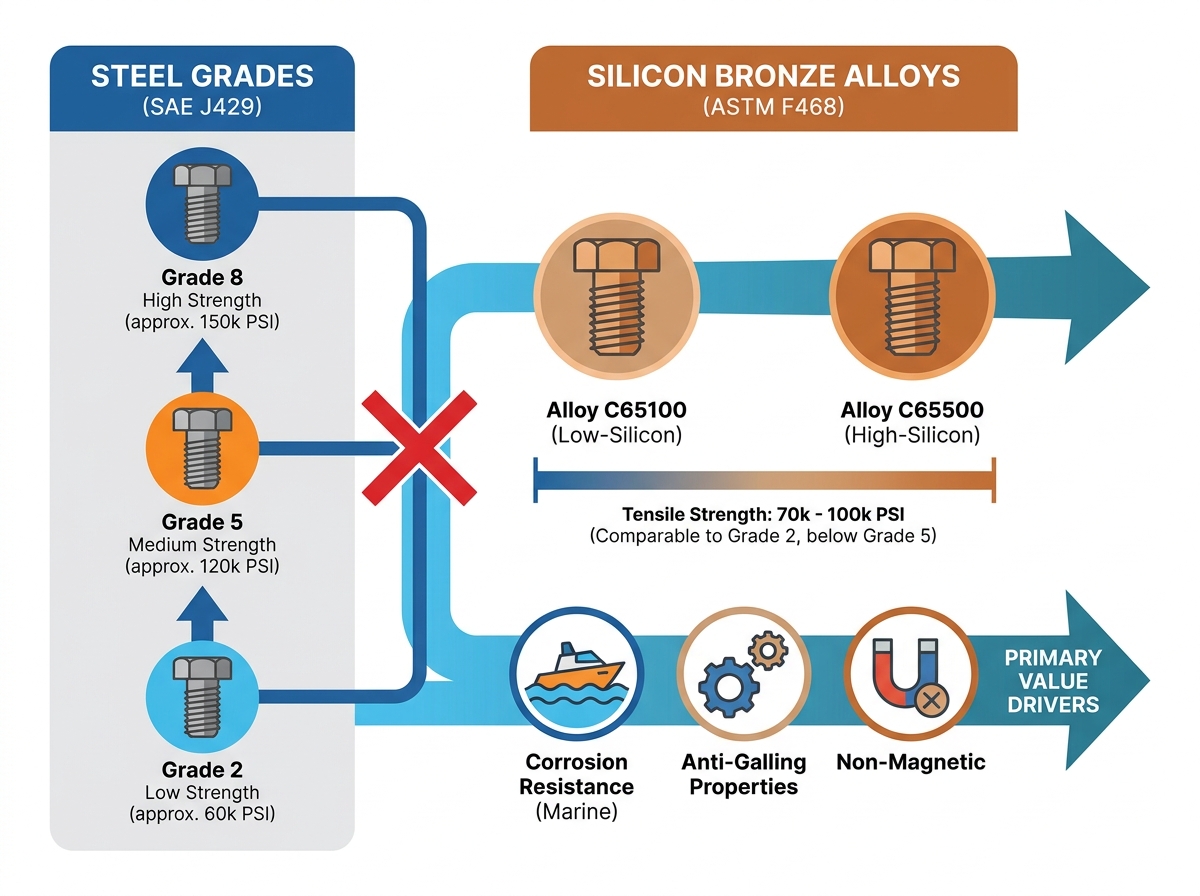
No Standard Steel Grades: Silicon bronze bolts do not use SAE grades or metric property classes; they are specified by alloy numbers (e.g., C65100, C65500).
Strength Profile: The tensile strength of a standard silicon bronze bolt typically ranges between 70,000 and 100,000 PSI, placing it roughly equivalent to or slightly above Grade 2 steel, but below Grade 5.
Primary Value Drivers: They are selected for exceptional marine corrosion resistance, anti-galling properties, and non-magnetic requirements, not for sheer tensile strength.
Specification Standard: Legitimate suppliers will certify these bolts against ASTM F468 (Standard Specification for Nonferrous Bolts, Hex Cap Screws, and Studs).
Engineers usually rely on straightforward grading systems for structural connections. However, these systems only apply to specific metal families. We must shift our perspective when moving from ferrous to non-ferrous materials. The metallurgical properties of copper alloys demand a different classification framework.
The Society of Automotive Engineers (SAE) developed the familiar J429 standard. This specific document gives us standard designations like Grade 2, Grade 5, and Grade 8. SAE J429 applies strictly to carbon and alloy steel fasteners. Non-ferrous metals require a completely different evaluation lens. We cannot force a copper alloy into a steel grading framework. Instead, we use the American Society for Testing and Materials (ASTM) system. ASTM standards evaluate the exact chemical composition and mechanical properties of the raw material.
You must reference correct documentation when specifying non-ferrous hardware. Two primary ASTM standards govern the production and certification of these specialized fasteners:
ASTM F468: This is the defining standard for non-ferrous bolts, hex cap screws, and studs for general use. It covers various commercial alloys, including copper, nickel, and titanium.
ASTM B98: This standard covers copper-silicon alloy rod, bar, and shapes. Manufacturers use this raw material standard before forging the final fastener.
Rather than asking for a specific grade, you must request a specific alloy. The Unified Numbering System (UNS) provides clear designations for commercial copper alloys. The two most common options include:
Alloy 651 (C65100): This is a low-silicon bronze. It provides excellent cold workability. Manufacturers frequently use C65100 for cold-headed bolts and smaller machine screws.
Alloy 655 (C65500): This represents high-silicon bronze. It offers higher baseline strength. Suppliers typically use C65500 for machined hardware or hot-forged fasteners in larger diameters.
Terminology matters in procurement. Many buyers mistakenly search for "silicone bronze" in supplier catalogs. Silicone is a synthetic polymer used in sealants and caulk. Silicon is a naturally occurring chemical element. The correct metallurgical term is "silicon bronze" (copper alloyed primarily with silicon). Using the proper term prevents procurement errors and ensures you access professional industrial catalogs.
Misunderstanding load capacity is a frequent point of failure in restoration projects. You must know the exact mechanical limits before swapping out rusty steel bolts.
Silicon bronze provides reliable, moderate strength. It generally offers a tensile strength ranging from 70,000 to 100,000 PSI. The final strength heavily depends on the exact manufacturing process. Cold working naturally increases the material's tensile limits. Hot forging maintains a slightly softer, more ductile internal grain structure. Its yield strength typically ranges between 35,000 and 55,000 PSI. This indicates the point where the metal permanently deforms under tension.
How does this material stack up against common industrial standards? We must look at direct comparisons to understand structural safety.
vs. Grade 2 Steel: Silicon bronze is generally stronger and far more reliable over time. It easily replaces standard low-carbon hardware.
vs. Grade 5 / Grade 8 Steel: Silicon bronze is significantly weaker. You cannot use it as a 1:1 drop-in replacement in high-shear or high-tension structural applications.
vs. 316 Stainless Steel: Both materials remain roughly comparable in overall tensile strength. However, the bronze alloy offers superior resistance to localized corrosion and thread galling.
Tensile Strength Comparison Chart
Material Category | Estimated Tensile Strength (PSI) | Common Application Profile |
SAE Grade 2 Steel | 74,000 (up to 3/4 inch) | Light duty, non-critical joints |
Silicon Bronze (C651/C655) | 70,000 - 100,000 | Marine structures, electrical panels |
316 Stainless Steel | 70,000 - 85,000 | General exterior, chemical exposure |
SAE Grade 5 Steel | 120,000 | Automotive, medium-stress machinery |
SAE Grade 8 Steel | 150,000 | Heavy equipment, high-shear structural |
Installation requires strict attention to detail. Mechanics face a high risk of over-torquing these parts. Because it lacks the high yield strength of graded alloy steel, you cannot use standard steel torque charts. Installation torque values must be strictly adjusted downward. Applying Grade 5 torque to a C65500 bolt will stretch the threads or shear the head completely off.
If they are weaker than high-strength steel, why do industries pay a premium for them? The answer lies in their specialized physical properties. They solve complex engineering problems in hostile environments.
Environmental durability drives almost every purchasing decision for this material. We must evaluate performance in demanding marine environments, brine, and sulfite solutions. The addition of silicon significantly boosts the natural corrosion resistance of copper. More importantly, it highlights immunity to dezincification. Brass fasteners contain high levels of zinc. Saltwater leaches the zinc out of brass, leaving a fragile, porous copper shell. Silicon bronze contains no zinc, completely eliminating this dangerous structural failure mode.
Maintenance teams constantly battle thread galling. Galling occurs when friction and pressure cause male and female threads to cold-weld together. Stainless steel is notoriously prone to this issue. We frequently choose copper alloys over stainless steel in applications requiring repeated maintenance. You can repeatedly remove and reinstall these fasteners without the threads seizing.
Magnetic interference ruins sensitive operations. We must carefully evaluate materials for use in sensitive electrical, medical, or navigational equipment. Standard steel creates unacceptable magnetic fields. Even some cold-worked stainless steels can become slightly magnetic. Silicon bronze remains purely non-magnetic under all manufacturing conditions. It is ideal for MRI machine rooms, mine-sweeping naval vessels, and high-voltage electrical switchgear.
Visual appeal plays a major role in custom fabrication. We note its extensive use in traditional woodworking and historic restoration. The raw metal weathers to a highly protective, visually appealing patina. It turns a muted olive-green or rich brown over time. This natural oxidation layer protects the underlying metal while complementing natural wood grains.
Finding the right dimensions can test your patience. The global supply chain heavily favors specific regional standards for copper-based hardware.
You must acknowledge regional manufacturing histories. Because this material is historically tied to US boat building and traditional wooden shipbuilding, imperial (inch) sizing dominates the market. Most domestic distributors stock extensive inventories of UNC (Unified National Coarse) and UNF (Unified National Fine) threads. Finding standard inch-sized carriage bolts, lag screws, and hex caps is generally straightforward.
Modern equipment often requires different thread standards. You must know how to properly source silicon bronze metric bolts to avoid assembly delays. Always evaluate dimensional requirements against international standards like DIN 931 for partial thread or DIN 933 for full thread profiles. Highlight lead-time risks early in your project planning. Metric variants often require custom manufacturing or international sourcing for bulk B2B orders. Domestic warehouses rarely stock obscure metric pitches in non-ferrous alloys.
Restoration projects require extreme caution regarding thread pitch. We warn heavily against forcing metric and imperial threads together. Emphasize the need for precise thread gauges when replacing older, degraded bronze hardware. An old 1/4-20 inch bolt looks deceptively similar to an M6x1.0 metric bolt. Forcing the wrong thread profile will permanently strip the receiving nut or tapped hole.
Even premium materials fail if deployed incorrectly. You must understand how this metal interacts with surrounding environments and project budgets.
Mixing metals creates hidden dangers. Outline the galvanic scale before designing any joint. Silicon bronze is highly noble (cathodic). If paired with active metals like aluminum or zinc-plated steel in a wet environment, a destructive electrical cell forms. The less noble metal acts as an anode and will rapidly corrode. Never use these fasteners to secure aluminum brackets on a boat hull. The aluminum will dissolve around the fastener.
Material budgets demand strict oversight. These parts are expensive because their pricing is directly tied to global commodity copper pricing. Provide a framework to prevent over-speccing your hardware. If marine corrosion or magnetic interference isn't a factor, you are wasting money. Coated Grade 5 steel or standard 304 stainless steel may offer a much better return on investment for inland, dry applications.
Assess the presence of continuous moisture or saltwater.
Determine if the joint requires frequent disassembly.
Evaluate the galvanic compatibility of the fastened materials.
Review the maximum shear and tensile loads expected.
Counterfeit or substituted materials pose massive safety risks. Advise buyers to always request Material Test Reports (MTRs) with their orders. An MTR provides certified chemical breakdowns from the metal mill. This document proves the alloy actually meets C65100 or C65500 standards. Strict documentation prevents the accidental purchase of cheaper, weaker brass disguised as a high-strength copper alloy.
Navigating the fastener market requires accurate terminology and realistic performance expectations. Do not look for a "Grade 8 silicon bronze bolt"—it simply doesn't exist. Engineers must base their buying decisions on specific ASTM F468 compliance. You are purposely balancing the need for superior environmental durability against a lower overall tensile strength compared to graded alloy steel.
Always verify your installation torque limits before assembly to prevent shear failures. Furthermore, cross-reference your material choices against a galvanic corrosion chart to protect surrounding metals. We highly recommend engaging with a specialized marine fastener distributor to verify these specifications and secure proper material certifications before issuing your final purchase order.
A: No, unless the engineering load allows for a significant reduction in tensile strength. Silicon bronze is generally weaker than Grade 5. Always recalculate joint requirements before swapping materials in structural applications.
A: They are roughly comparable to standard 18-8 or 316 stainless steel in overall tensile strength. However, they offer superior resistance to thread galling, making them much easier to remove after long-term exposure.
A: Specify the exact dimensions, thread pitch, and require compliance with ASTM F468 Alloy 651 or 655, rather than requesting a strength grade. Always request Material Test Reports (MTRs) to verify chemistry.
A: No. They contain no iron, so they cannot rust. They will oxidize over time, forming a protective green or brown patina that shields the inner core from further environmental degradation.