close
Choose Your Site
Global
Social Media
Views: 0 Author: Site Editor Publish Time: 2026-05-06 Origin: Site
The head of a silicon bronze hex bolt features a regular hexagonal prism structure; its six symmetrical faces provide ample contact surface for engagement with wrenches or sockets. This design enables the bolt to withstand tightening torques reaching tens of Newton-meters without slipping—a feature particularly well-suited for applications requiring high-strength pre-tensioning, such as in power infrastructure and heavy machinery. The width across the flats of the bolt head typically adheres to ISO 4014 or GB/T 5782 standards, creating a distinct aesthetic of industrial geometry.
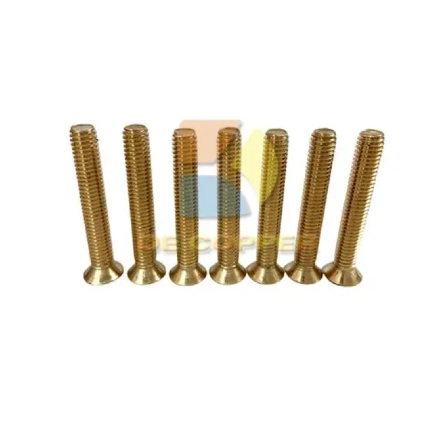
In contrast, the head profile of a silicon bronze countersunk bolt resembles a flattened disc, characterized by a smooth, rounded transition at the top and cylindrical—or slightly tapered—vertical sides. This "shallow-dish" configuration results in a head height significantly lower than that of a hex bolt, yielding an overall profile that is more low-profile and unobtrusive. Countersunk bolts are typically designed for use with Phillips, slotted, or internal hex drives, where the installation tool engages vertically from the top of the head rather than applying force by encircling the head from the side.
In terms of spatial footprint, hex bolts require radial clearance to accommodate the rotation of a wrench, whereas countersunk bolts merely require an axial channel for tool access; this fundamental difference directly defines the respective limits of their applicability within compact structural assemblies.
The hexagonal geometry of a hex bolt facilitates a uniform distribution of torque across its faces. When a wrench grips the bolt head, contact stresses are dispersed over the substantial surface area of the six sides, thereby effectively mitigating the risk of localized crushing. Silicon bronze, as a material, inherently possesses excellent tribological properties; the inclusion of silicon imparts a tendency toward self-lubrication, resulting in significantly lower adhesive wear within the threaded assembly during repeated installation and removal cycles compared to standard brass.
The torque transmission mechanism for countersunk (flat-head) bolts, however, differs entirely. These bolts rely on the engagement between the recessed feature at the top of the head—such as a Phillips cross-recess or a Slotted drive—and a corresponding screwdriver to achieve rotational drive. This method of torque transmission, characterized by point or line contact, generates significantly higher contact stresses under an equivalent tightening torque. When applied to relatively soft non-ferrous metals—such as silicon bronze—particular attention must be paid to the potential for the edges of the drive recess to crush or deform. In engineering practice, the recommended tightening torque for countersunk bolts is typically 15% to 20% lower than that for hex bolts of the same nominal size.
In terms of resistance to loosening, when a hex bolt is paired with a spring washer or a double-nut configuration, the interface between the underside of the bolt head and the washer constitutes an annular surface contact, ensuring a stable coefficient of friction. Conversely, while the underside of a countersunk bolt head is also flat, these bolts are frequently deployed in space-constrained environments where the use of standard anti-loosening washers is often impractical; consequently, they rely more heavily on thread-locking adhesives or nylon-insert locknuts to prevent loosening.
Despite their distinct head configurations, both types of bolts share the core material advantages of silicon bronze alloys. Represented by UNS C65100 and C65500, the silicon bronze family typically features a copper content exceeding 94%, with silicon content controlled within the range of 2.75% to 3.8%, supplemented by micro-alloying elements such as manganese and zinc.
This material system endows the bolt with three unique properties:
Corrosion Resistance: Silicon bronze exhibits exceptional chemical stability in marine atmospheres, salt-spray environments, and sulfur-containing media. A dense, composite passivation film—composed of silicates and copper oxides—forms on its surface, resulting in a corrosion rate significantly lower than that of carbon steel and even certain grades of stainless steel. In applications such as coastal power facilities and ship decks, the service life of silicon bronze bolts can be three to five times longer than that of standard galvanized steel bolts.
Non-Magnetic and Explosion-Proof Properties: Silicon bronze is a quintessential non-ferromagnetic material with a magnetic permeability close to 1.0. This characteristic makes it the fastener of choice for minesweeping equipment and for structural components surrounding Magnetic Resonance Imaging (MRI) facilities. Furthermore, as a copper-based alloy, it does not generate sparks upon impact or friction, rendering it suitable for use in explosive environments such as those found in the petrochemical industry.
Balancing Electrical and Thermal Conductivity: The electrical conductivity of silicon bronze is approximately 15% to 20% that of pure copper; while not as exceptional as that of pure copper, it is significantly superior to that of stainless steel. In power generation and distribution applications—such as grounding connections and busbar fastening—silicon bronze bolts provide mechanical securement without introducing excessive contact resistance.
The primary application scenarios for hex bolts are characterized by distinct features: "heavy-duty, exposed, and maintainable."
Power Transmission and Distribution Towers: The gusset plate connections of transmission line towers must withstand conductor tension and wind loads; the use of hexagonal heads facilitates high-altitude operations by enabling workers to utilize torque wrenches for standardized pre-tensioning.
Water Treatment and Chemical Piping: Silicon bronze hex bolts are utilized at flanged connections to resist chloride-induced stress corrosion cracking; their hexagonal heads facilitate tool access from multiple angles within narrow pipe trenches.
Marine Propulsion Systems: Components such as main engine mounts and vibration dampers require periodic retightening; the hexagonal configuration facilitates repeated assembly and disassembly without susceptibility to damage.
Countersunk head bolts, meanwhile, specialize in the niche market defined by "compactness, concealment, and aesthetics."
Precision Instrument Enclosures: For securing the cover plates of electronic equipment chassis and marine instrument housings, countersunk head bolts are utilized to ensure the bolt heads do not protrude above the surface, thereby preventing accidental bumps or injuries to personnel and maintaining a clean, streamlined appearance.
Woodwork Decoration: In yacht interiors and outdoor wooden landscaping features, silicon bronze countersunk bolts are utilized in conjunction with counterbored holes. Their heads can be fully embedded flush with the wood surface—becoming virtually invisible after sanding—while the natural antimicrobial properties of the copper alloy simultaneously provide protection against mold and mildew in humid environments.
Electrical Terminals: Designed for securing PCBs and fastening terminal posts within distribution boxes. The low-profile countersunk head structure conserves panel space, while the Phillips recess facilitates rapid assembly using power screwdrivers.
From a manufacturing process perspective, the cold heading technique for forming hexagonal bolt heads is more mature; the hexagonal structure facilitates uniform metal flow within the die, resulting in high material utilization. For larger-sized products (e.g., M20 and above), a method involving hot forging followed by machining can be employed, making the precise control of the head's across-flats dimensions relatively easy to achieve.
In contrast, the heading process for countersunk bolts demands higher die precision—particularly regarding the formation of the head recess (such as Phillips or Torx patterns), which typically requires a multi-station progressive die setup, leading to faster die wear. When working with materials that exhibit higher deformation resistance than standard carbon steel—such as silicon bronze—the theoretical defect rate during countersunk bolt head formation (e.g., incomplete filling or cracking) is slightly higher than that of hexagonal bolts.
In terms of cost, hexagonal bolts of the same size and material typically hold a price advantage, driven by their higher production efficiency and lower die depreciation. The price premium associated with countersunk bolts primarily stems from the precision heading operations and subsequent deburring processes. However, in end-use applications, if the selection of countersunk bolts eliminates the need for additional counterboring operations or the installation of protective covers, their overall cost-effectiveness may, in fact, prove to be more competitive.
Torque Capacity:High; suitable for high-preload connections.
Installation Space:Requires radial clearance for wrench access.
Visual Concealment:Exposed head; strong industrial aesthetic.
Repeated disassembly and assembly:Excellent quality; the head is highly durable.
Anti-loosening Configuration:Standard washers and cotter pins are available.
Typical Scenarios:Power Transmission Towers, Marine Propulsion, Chemical Pipelines
Torque Capacity:Low to medium; suitable for light to medium loads.
Installation Space:Requires only an axial tool channel.
Visual Concealment:Can be flush-mounted or recessed for a sleek, aesthetic appearance.
Repeated disassembly and assembly:Generally, the notch presents a risk of wear.
Anti-loosening Configuration:Relies heavily on threadlocker or locknuts.
Typical Scenarios:Instrument Panel, Woodwork Accents, Compact Structure
Silicon bronze hex bolts and countersunk bolts do not merely serve as simple substitutes for one another; rather, they represent distinct structural manifestations of the same high-performance material, shaped by differing engineering philosophies. Hex bolts prioritize mechanical reliability—often at the expense of a flush profile—while countersunk bolts prioritize visual aesthetics and ease of installation, even if this entails certain spatial compromises. In high-end sectors such as marine engineering, clean energy, and explosion-proof electrical systems, engineers’ selection criteria must transcend the singular dimension of "strength-first." Instead, they must adopt a holistic approach that integrates factors such as maintenance accessibility, aesthetic requirements, spatial constraints, and total lifecycle costs to ensure that the inherent advantages of silicon bronze alloys are fully realized.